Vanadium-Flow Batteries: The Energy Storage Breakthrough We’ve Needed
The latest, greatest utility-scale battery storage technology to emerge on the commercial market is the vanadium redox battery, also known as the vanadium flow battery.
V-flow batteries are fully containerised, nonflammable, compact, reusable over semi-infinite cycles, discharge 100% of the stored energy and do not degrade for more than 20 years.
Most batteries use two chemicals that change valence (or charge or redox state) in response to electron flow that convert chemical energy to electrical energy, and vice versa. V-flow batteries use the multiple valence states of just vanadium to store and release charges.
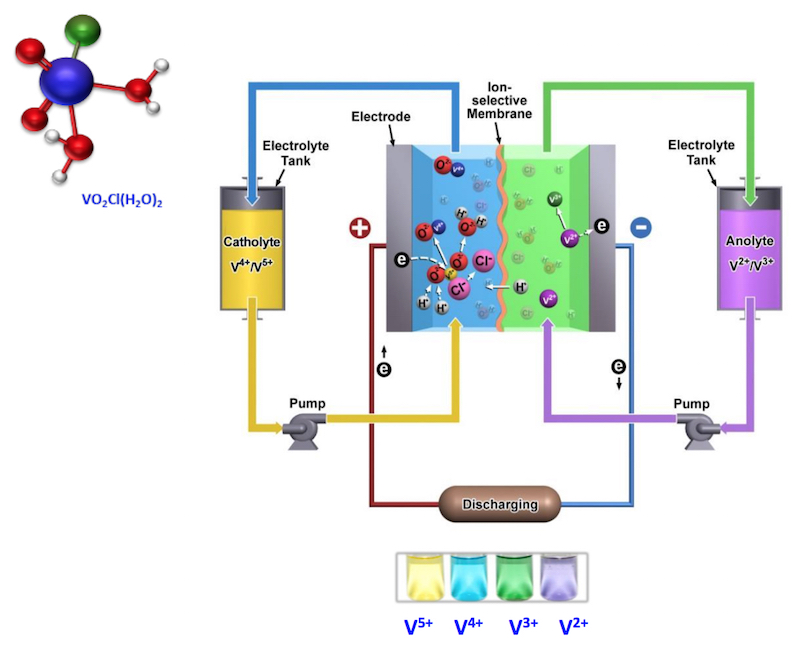
V can exist as several ions of different charges in solution, V(2+,3+,4+,5+), each having different numbers of electrons around the nucleus. Fewer electrons gives a higher positive charge. Energy is stored by providing electrons making V(2+,3+), and energy is released by losing electrons to form V(4+,5+).

Vanadium flow batteries use the multiple valence states of vanadium to store and release charges. Energy is stored by providing electrons making V(2+,3+), and energy is released by losing electrons to form V(4+,5+). Source: UET
Flow batteries consist of two tanks of liquid, which simply sit there until needed. When pumped into a reactor, the two solutions flow adjacent to each other past a membrane, and generate a charge by moving electrons back and forth during charging and discharging.
This type of battery can offer almost unlimited energy capacity simply by using larger electrolyte storage tanks. It can be left completely discharged for long periods with no ill effects, making maintenance simpler than other batteries. Because of these unique properties, the new V-flow batteries reduce the cost of storage to about 5¢/kWh.
These batteries are rather large and best suited to industrial and utility scale applications. They could never fit in an electric car, so the Tesla battery is safe for now. But the V-flow battery outcompetes Li-ion, and any other solid battery, for utility-scale applications. They’re just safer, more scalable, longer-lasting and cheaper – less than half the cost per kWh.
If you want to know more about this and other topics directly from end users of energy storage technologies join us at one of these annual events: The Energy Storage World Forum (Grid Scale Applications), or The Residential Energy Storage Forum, or one of our Training Courses.