
6
Sep

More Utilities take a strategic approach to solar and energy storage

Utility-scale storage projects are on the rise and the storage market is expected to reach 2.6 gigawatts (GW) in 2022, according to GTM Research. The global annual utility-scale energy storage power capacity additions are expected to grow from 1,158.8 MW in 2017 to 30,472.5 MW by 2026, according to new report published by Navigant Research.

Storage installations create opportunities for utilities wishing to smooth ramping requirements, optimize the system to boost grid reliability, power quality, load leveling, facilitate the integration of renewables. As technologies improve and the number of energy storage projects increases, the cost of energy storage is declining, thus creates a new opportunity for extra revenue streams.

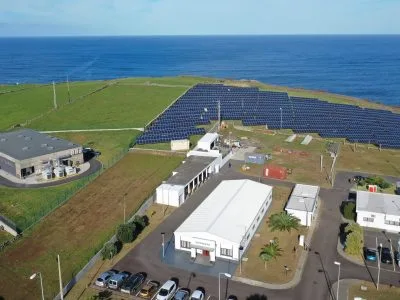
Battery storage pairs well with renewables and enhances their operability by shifting power delivery to match in real-time demand. California utilities have deployed successfully many solar-plus-storage systems and continue to seek new projects. Utilities from states such as Arizona, New Mexico, Florida are also researching the ways to implement energy storage into their grids and look beyond the tactical level in order to best position themselves and enhance their services.

Utility-scale solar prices have fallen below $1/watt as technology costs decline. Battery storage systems can supply dispatchable energy for several hours thus overcoming the intermittency of renewables. This also can help the utility smooth out fluctuations, as well as optimize the transmission system.

Read the original article

Image credit: SolarCity

If you want to know more about this and other topics directly from end users of energy storage technologies join us at one of these annual events: The Energy Storage World Forum (Grid Scale Applications), or The Residential Energy Storage Forum, or one of our Training Courses.
LATEST ARTICLES

Future energy predictions: Growth of flexibility and grid forming

  It is well known that COVID-19 has caused low energy demand and the growth of renewable energy across Europe. Now, Andrew Tang, Vice President for Energy Storage at Wärtsilä, predicts this will result in swift action to build better grid resiliency. The share of renewable power across Europe has skyrocketed over the last six…

Read More

Energy Storage Systems: the role of an Integrator

Simplifying BESS deployments by mastering their associated risks With the introduction of Battery Energy Storage Systems ‘BESS’, a new role has been created on the value chain. It is the role of a BESS integrator. The role of an integrator can be misunderstood at times or blended with other roles at other times. This is…

Read More

Ultracapacitor UPS (U-UPS) for voltage dips and micro-interruptions

Power interruptions are the most frequent power supply problems with wide-ranging consequences for industry. The causes of these interruptions include short-circuits in the distribution grid, lightning strikes, the connection and disconnection of power plants as well as volatile energy producers such as wind and solar. Because technologies and production processes are becoming increasingly complex, the…

Read More

★REVIEWS

[gdlr_testimonial columns="1" type="static" style="box-style"]
[gdlr_tab title="Sales Director" position="S&C"]“Probably the most interactive and well organized storage event on the calendar.”
★★★★★[/gdlr_tab]

[gdlr_tab title="TLC & SCADA Manager" position="FRI-EL"]“Great topics, competent speakers, good networking: keep it like that.”
★★★★★[/gdlr_tab]

[gdlr_tab title="Expert Technical & Governance" position="Elia"]“High scientific content, well targeted, perfect organization.”
★★★★★[/gdlr_tab]

[gdlr_tab title="Manager" position="ATL"]Excellent networking event. The sponsorship was well worth it.”
★★★★★[/gdlr_tab]
[/gdlr_testimonial]

View More

x